
Portugal is the most underpriced destination in Western Europe - and that gap is closing fast. Lisbon hotel rates have doubled since 2018. Sintra on a summer weekend now has queues at the palace gates that rival Barcelona. And yet Portugal still offers a genuinely extraordinary amount for the money: a €31 Lisboa Card unlocks 51 attractions plus unlimited public transport, a Fado concert in a tiled Alfama venue runs €15-€28, and the Douro Valley produces some of the world's finest wine at cellar-door prices most tourists never discover. This guide tells you exactly where the value is, which attractions are overhyped, and how to structure a trip that leaves you thinking Portugal was the best decision you made all year.
This post contains affiliate links. If you book through them, I earn a small commission at no extra cost to you - it helps keep this blog running. Thank you!
Start here: Portugal's top-rated attraction tickets with real-time prices - Lisboa Card, Jerónimos Monastery, Sintra palaces, Porto experiences, and Algarve parks all in one place. Prices shift significantly by season so checking current rates before booking saves real money.
Getting to Portugal: Flights, Airports, and Getting Around
Lisbon Humberto Delgado Airport (LIS) handles most international arrivals and sits just 7 km from the city center - the closest major airport to a capital in Europe. Return flights from London run £60-£160 with TAP, easyJet, or Ryanair; from New York expect $380-$650 return. Porto Francisco Sa Carneiro Airport (OPO) is the entry point for northern Portugal, with a metro line direct to the city center (€2.30, 35 minutes). Faro Airport (FAO) serves the Algarve and receives most UK package tourists.
| Airport | Transport to City | Cost | Time |
|---|---|---|---|
| Lisbon (LIS) | Metro Line Vermelho | €1.65 + €0.50 card | 25 min to Alameda |
| Lisbon (LIS) | Aerobus 1 | €4.00 one-way | 30-45 min |
| Lisbon (LIS) | Taxi | €15-€22 fixed zone | 15-25 min |
| Porto (OPO) | Metro Line E (Violet) | €2.30 | 35 min to Trindade |
| Faro (FAO) | Bus (Eva/Proximo) | €2.50 | 30 min to Faro center |
Between cities, the Alfa Pendular train from Lisbon Santa Apolónia to Porto Campanha takes 2h45m and costs €25-€45 booked in advance on cp.pt. The Algarve from Lisbon by train is 2h45m to Faro (€22-€35). Renting a car makes the most sense for the Alentejo, Douro Valley, and the quieter parts of the Algarve - from €30/day for a basic hatchback. Portuguese driving is assertive but the roads are good.
When Is the Best Time to Visit Portugal?
March, April, May, and October are the best months to visit Portugal. Temperatures in Lisbon run 18-24°C, the country is green from winter rains, and major attractions have their shortest queues of the year. Hotel rates in these shoulder months run 25-40% lower than July and August. The Algarve beaches in May are warm enough for swimming (18-20°C sea temperature) with half the crowd of peak summer.
July and August peak at 35-40°C in Lisbon and inland Portugal - genuinely uncomfortable for extended walking. Sintra on a summer weekend has queue times of 60-90 minutes at the Pena Palace gate. The Algarve in August is packed beyond comfort at most beaches. That said, the long evenings (sunset after 9pm), outdoor dining culture, and festival season make summer uniquely Portuguese in feel. Come in June if you want summer without the worst of it - temperatures are 5-8°C lower than August and the crowds haven't peaked yet. Winter (November-February) offers the cheapest hotels, near-empty museums, and Atlantic surf season - not beach weather, but not cold either (12-16°C in Lisbon).
Top Things to Do in Lisbon (With Real Prices)
Lisbon is one of the most rewarding capital cities in Europe for the money. The Lisboa Card covering 51 attractions plus unlimited public transport (€31 for 24h, €51 for 48h, €62 for 72h) is genuinely good value if you plan to visit 3+ paid attractions in a day - the Jerónimos Monastery, Oceanário, and São Jorge Castle alone cover the card cost.
Jerónimos Monastery
The most important building in Portugal. Built in 1502 to celebrate Vasco da Gama's return from India, the Jerónimos Monastery is the defining example of Manueline architecture - the uniquely Portuguese style that mixes Gothic structure with maritime and exotic motifs brought back by Age of Discovery explorers. Entry is €18 (free for EU residents under 25 with ID). Buy Jerónimos Monastery skip-the-line tickets online - summer walk-up queues run 40-60 minutes. The double-storey cloister is the photographic centrepiece: 55 metres square, carved stone that looks more like coral than masonry. Budget 1.5-2 hours minimum.
 The Alfama district - Lisbon's oldest neighborhood, home to authentic Fado venues and São Jorge Castle
Oceanário de Lisboa
Rated 4.7 stars from over 7,000 reviews and consistently ranked among the best aquariums in the world. Entry is €25 for adults, €17 for children. The central tank - 5 million litres, housing sunfish, sharks, rays, and schools of fish in open ocean - is genuinely astonishing. Built for Expo '98 in the Parque das Nações waterfront district, the building sits in the Tagus estuary with water on three sides. Book Oceanário de Lisboa tickets online to skip the often substantial weekend queues. Allow 2 hours.
Belém Tower and the Belém District
The Belém Tower (€15 entry) is the postcard image of Lisbon - a 16th-century fortified tower standing in the Tagus River near the point where Portuguese explorers departed for Africa, Brazil, and India. Honest assessment: the exterior is significantly more impressive than the interior. The 3.8 rating reflects this. Book Belém Tower tickets in advance regardless, since the daily visitor cap means walk-up availability runs out by late morning in summer. The Belém district around it is excellent: the Monument to the Discoveries (€10), the Pastéis de Belém bakery where the original custard tart recipe has been made since 1837 (queue 20-30 minutes, worth it).
Sao Jorge Castle and the Alfama
São Jorge Castle sits on the highest hill in central Lisbon with 360-degree views over the city, the Tagus, and the April 25th Bridge. Entry is €15, included in the Lisboa Card. The Moorish fortifications date from the 8th century. The Alfama neighborhood below the castle is the oldest district in Lisbon - narrow cobbled streets, tiled facades, and the highest concentration of authentic Fado venues in the city. Explore it in the evening when the neighborhood comes alive.
Fado Concert: The Music Worth Booking Before You Arrive
Fado is Portugal's melancholy urban folk music - UNESCO-listed since 2011. A good Fado dinner show runs €45-€80 including dinner; a concert-only experience starts from €15.20 at smaller venues. The difference between a tourist trap show and a genuinely moving experience is usually the venue size and proximity to the singer. Book Fado concert tickets in Lisbon ahead for the best venues - top performances sell out 5-7 days ahead on Friday and Saturday evenings.
- Museu Nacional do Azulejo: €10 entry. 700 years of Portuguese tile art in a converted convent. Free on the first Sunday of the month. Budget 90 minutes.
- LX Factory: Free to enter. A converted 19th-century industrial complex with independent shops and the best Sunday market in Lisbon (10am-6pm).
- Tram 28: €3.50 per journey or included in Lisboa Card. The famous yellow tram through the Alfama and Graca neighborhoods. Go early morning to avoid peak crowds.
- Miradouros (Viewpoints): Free. Miradouro da Graca and Miradouro de Santa Catarina have the best views with the least tourists.
- Time Out Market: Free entry. 35 restaurants and bars under one roof in the Cais do Sodre market building. Budget €15-€25 per person for a meal.
Day Trips from Lisbon: Sintra, Cascais, and the Setubal Peninsula
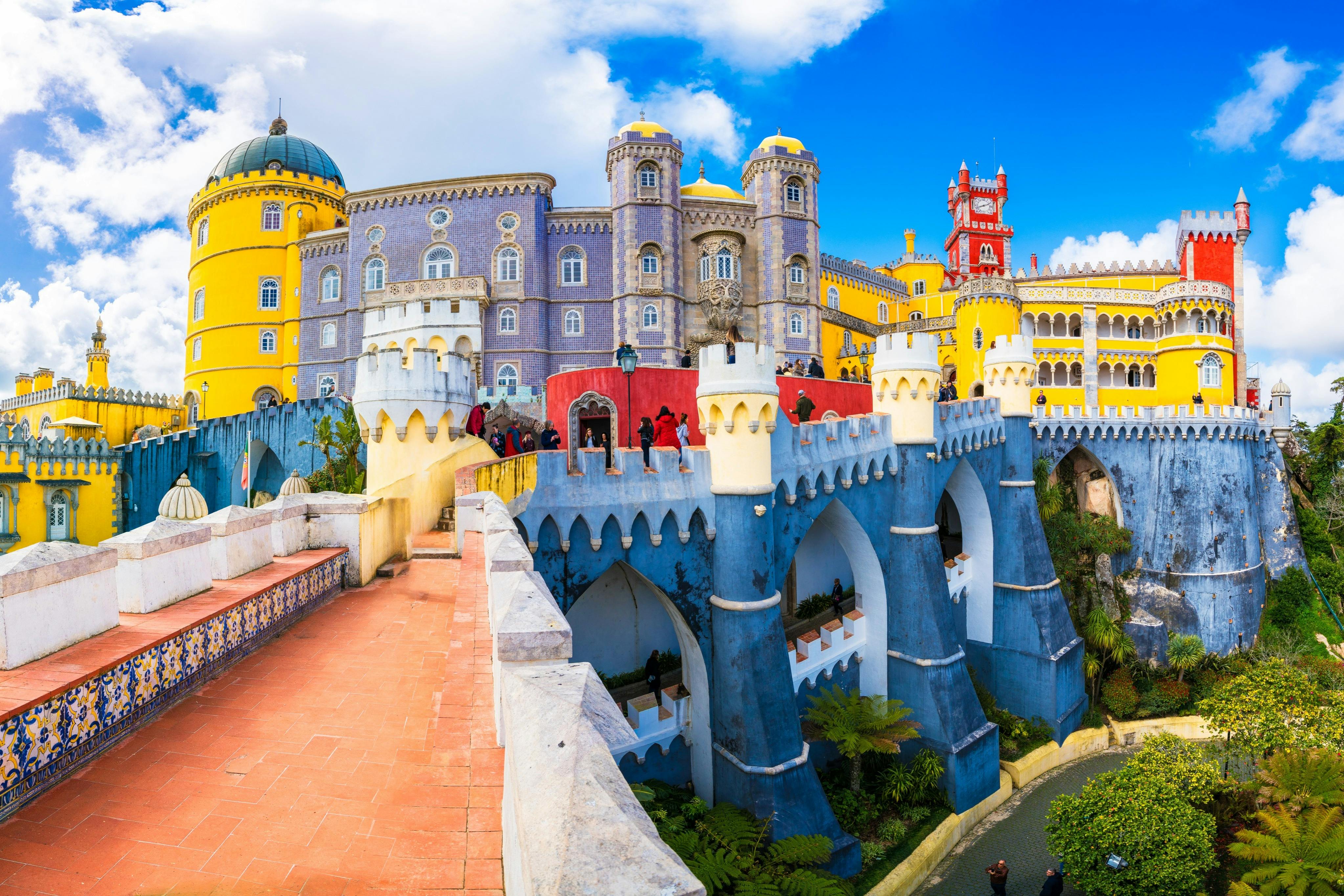
 The National Palace of Pena in Sintra - a Romanticist masterpiece perched above the clouds
Sintra is 40 minutes from Lisbon Rossio station by train (€2.35 each way, every 30 minutes). The National Palace of Pena (€10.96 entry) is the most dramatic: a 19th-century Romanticist palace painted in yellow and red sitting above the clouds on Sintra's highest peak. Book Pena Palace tickets and Sintra attraction combo packages well in advance - July and August see queues of 90 minutes at the palace gate even with pre-booked timed entry. The Quinta da Regaleira (€12) has underground initiation wells, tunnels, and one of the most surrealist gardens in Europe.
Cascais is 40 minutes west of Lisbon by train (€2.45 each way) and combines a historic fishing town with excellent beaches. The beaches at Guincho (15 minutes by bus from Cascais) are Atlantic-facing, wild, and popular with surfers. The Setubal Peninsula south of Lisbon has the best beaches within day-trip range: Portinho da Arrabida has water that looks Mediterranean in clarity and color.
Porto and the Douro Valley: Why Northern Portugal Deserves More of Your Trip
 Porto's Ribeira waterfront with Port wine lodges in Vila Nova de Gaia across the Douro River
Porto is the most photogenic city in Portugal. The Ribeira waterfront - colored houses stacked up the hillside, Port wine lodges across the river in Vila Nova de Gaia, the Dom Luis I bridge connecting both banks - is the image that defines the country internationally. The Clérigos Tower entry ticket costs €10 for the baroque bell tower with 360-degree views over Porto's terracotta rooftops. The Porto Cathedral (€4 entry, 4.3 stars from 2,500+ reviews) is the oldest monument in the city, dating from the 12th century.
The Port wine lodge experience across the river in Vila Nova de Gaia is mandatory. Taylor's, Graham's, and Sandeman all run tours (€15-€20 including tastings). The Douro Valley above Porto - accessible by train (€15, 2 hours) or river cruise - produces the world's Port wine. A Douro River cruise from Porto costs from €20 and takes 6 hours including wine estate visits.
The Algarve: What the Beach Brochures Don't Tell You
The Algarve's 200 km of Atlantic coastline is genuinely extraordinary - sea stacks, grottos, golden limestone cliffs, and water that cycles between green and deep blue. The western Algarve (Lagos, Sagres, Aljezur) is wilder and less developed; the central Algarve (Albufeira, Vilamoura) is where package tourism concentrates; the eastern Algarve (Tavira, Cacela Velha) is the least visited and arguably the most beautiful.
For families, the Algarve water parks deliver. Aquashow Park in Quarteira (€30.60, 4.7 stars from 2,744 reviews) has the largest wave pool in Portugal. Zoomarine in Guia (€34.91, 4.7 stars from 3,935 reviews) combines marine shows with water park facilities. Both are worth booking Algarve park tickets online 2-3 days ahead in July-August when they hit capacity. The cliff walk between Praia da Marinha and Benagil Cave (free, 2.5 km) is among the most dramatic coastal walking in Europe.
Where to Stay in Portugal: Best Neighborhoods by Budget
Lisbon has the most hotel options and the widest price range. Porto is smaller and more walkable. The Algarve requires a car if you're staying outside Albufeira or Lagos town centers.
- Lisbon - Chiado and Bairro Alto: Best for walkable central access. Mid-range hotels from €90/night, boutique from €140/night. Noisy after midnight on weekends - request a quiet room.
- Lisbon - Alfama: Best for atmosphere and Fado. Guesthouses from €55/night, boutique from €100/night. Hilly and cobbled - not ideal with heavy luggage.
- Lisbon - Intendente and Mouraria: The emerging affordable area. Budget from €40/night, mid-range from €70/night. 10 minutes walk to central sights.
- Porto - Ribeira and Baixa: Best for the classic Porto experience. Mid-range from €75/night, boutique from €110/night.
- Algarve - Lagos Old Town: Best base for western Algarve. B&Bs from €55/night, mid-range hotels from €80/night. Walking distance to beaches and an excellent restaurant scene.
Book Lisbon and Porto stays 6-8 weeks ahead for spring and autumn. Bundle hotel-adjacent attraction deals and combo packages can save €10-€20 per person versus booking separately.
How Much Does Portugal Cost? A Real Daily Budget Breakdown
| Category | Budget Traveler | Mid-Range | Luxury |
|---|---|---|---|
| Accommodation | €25-€55/night | €75-€140/night | €180-€450/night |
| Food | €15-€25/day | €35-€60/day | €80-€180/day |
| Transport | €5-€10/day | €10-€20/day | €20-€50/day |
| Activities | €10-€25/day | €35-€65/day | €80-€180/day |
| Daily Total | ~€55-€115 | ~€155-€285 | ~€360-€860+ |
Portugal is the most affordable Western European country for travel. A full sit-down lunch (prato do dia) costs €8-€12 at any non-tourist restaurant. Dinner for two with wine at a good local tasca: €30-€45. The Lisboa Card for access to all major Lisbon attractions works out to roughly €10-€12 per attraction when used across 3 days - significantly cheaper than paying individually. The 72h card at €62 covers Jerónimos, Oceanário, Belém Tower, São Jorge Castle, and unlimited Tram 28 rides with money left over.
Practical Tips Before You Visit Portugal
EU citizens and UK passport holders enter visa-free for stays under 90 days. Currency is Euro. ATMs are widely available - avoid airport exchange counters (rates run 8-12% worse). Use a Revolut or Wise card for zero-fee withdrawals. Language: Portuguese is not Spanish. 'Obrigado' (thank you) and 'bom dia' (good morning) are genuinely appreciated. Tipping is optional - rounding up or leaving coins is sufficient.
Lisbon's hills are genuine - comfortable shoes with grip are not optional. The cobblestones (calçada portuguesa) are beautiful and legitimately slippery when wet. The restaurant 'couvert' (bread, olives, and butter placed automatically on the table before you order) costs €2-€5 per person and is charged if you eat it. You're allowed to politely decline it or ask for it to be removed. Tap water is safe to drink everywhere in Portugal.
My Honest Take on Portugal
Portugal is one of the few European countries where the gap between what people expect and what they actually find still runs in the traveler's favor. Lisbon is more interesting than people who've only seen the headline landmarks realize - the Alfama alone at 8pm, with Fado drifting out of a small restaurant window and the city lights below, is one of the best free experiences in Europe. Porto is the city most travelers say they wish they'd given more time to. The Algarve is genuinely one of the most beautiful coastlines on the continent.
The honest warning: Sintra in peak summer is overcrowded to the point of diminishing returns - go in spring or autumn or accept the queues. Lisbon's growing tourism has pushed restaurant prices in the most central areas up sharply. The solution is simple: walk 10 minutes from any postcard landmark and prices drop back to what makes Portugal worth coming to. Start planning with Portugal's top-rated experiences and current attraction prices - the Lisboa Card, Sintra palace tickets, Fado shows, Porto experiences, and Algarve parks are all there. Book the flagship attractions before you land. Everything else, figure out when you arrive.


