
France is the most visited country on earth - 100 million tourists a year - and it still manages to surprise people who think they know exactly what to expect. Paris alone has 130 world-class museums, 450 parks, and a Seine riverbank UNESCO listed since 1991. But the travelers who remember France most aren't the ones who ticked off the Eiffel Tower and flew home. They're the ones who took the train to Mont-Saint-Michel, stood inside Sainte-Chapelle when the stained glass turned gold, or ate a €9 lunch in a Marais bistro with no English menu on the wall. This guide covers what those experiences actually cost, where the value is, and where France's famous tourist industry extracts money without delivering much in return.
This post contains affiliate links. If you book through them, I earn a small commission at no extra cost to you - it helps keep this blog running. Thank you!
Start here: France top attraction tickets with current prices and availability - Seine cruises, Arc de Triomphe, Musée d'Orsay, Versailles, Mont-Saint-Michel, and more in one place. Prices shift by season so checking current rates before booking saves real money.
Getting to France: Flights, Trains, and Getting Around
Paris Charles de Gaulle (CDG) is the main international gateway, 25 km northeast of the city. Return flights from London run £60-£160 on easyJet, Eurostar, or British Airways; from New York expect $380-$700 return. The Eurostar from London St Pancras to Paris Gare du Nord takes 2h15m and costs £60-£200 depending on how far ahead you book - the £60 tickets sell out fast, but £80-£100 is achievable 3-4 weeks ahead. From within Europe, the train network is extensive and often cheaper and faster than flying when you factor in airport time.
| Route | Transport Option | Cost | Journey Time |
|---|---|---|---|
| CDG Airport to Paris | RER B train | €11.80 one-way | 35-45 min to city center |
| CDG Airport to Paris | Taxi | €55 fixed (Left Bank), €50 (Right Bank) | 30-60 min |
| CDG Airport to Paris | Uber | €35-€50 | 30-60 min |
| London to Paris | Eurostar | £60-£200 | 2h15m |
| Paris to Lyon/Marseille | TGV high-speed train | €30-€100 | 2h / 3h15m |
Inside Paris, the metro is excellent - 16 lines, €1.73 per single journey with a 10-trip carnet (€17.35) or €8.65 for a 1-day unlimited Navigo Jour pass. The city is also genuinely walkable: the Louvre to Notre-Dame is 12 minutes on foot, Musée d'Orsay to the Eiffel Tower is 20 minutes. For day trips (Versailles, Mont-Saint-Michel, Loire Valley), the SNCF train network is the most efficient option - book on sncf-connect.com at least 2-3 weeks ahead for the best prices.
When Is the Best Time to Visit France?
April, May, June, and September are the best months to visit France. Paris in spring (18-22°C) has the light that Impressionist painters spent their careers trying to capture - it's not a cliché, it's genuinely different. June gives you long days (sunset after 9:30pm) without July's crowds. September brings harvest season in Burgundy and Champagne, fewer tourists at Versailles, and hotel rates 20-30% lower than peak summer.
July and August are the paradox months: peak tourist season but also when Parisians leave. The city empties of locals, many neighborhood restaurants close for the month, and the major attractions hit their highest crowds and prices. The Louvre queues in August can hit 90 minutes. Versailles gardens are 40% more expensive in peak season. That said, outdoor experiences - river cruises, rooftop bars, open-air cinema - are at their best in summer. Winter (November-February) offers dramatically lower prices, minimal queues at the Louvre and Musée d'Orsay, and a Paris that looks like the film set people imagined. Cold but functional.
Top Things to Do in Paris (With Real Prices and Queue Times)
Paris has more genuinely world-class attractions than any other city in Europe. The challenge is not finding things to do - it's choosing which queues are worth standing in.
Eiffel Tower
Everyone goes. Most people spend too long waiting. The summit lift ticket is €28.30 for adults; the second floor is €18.80. Book online at least 2-3 weeks ahead - walk-up queues in summer run 90-120 minutes even with a timed entry. The best experience at the Eiffel Tower is not the summit view (good but not dramatically better than the second floor) - it's the Champ de Mars lawn at dusk when the hourly light show starts. That costs nothing. Bring a bottle of wine from a nearby Nicolas shop (€8-€12) and join the 10,000 people doing exactly the same thing.
The Louvre
Entry is €22 online, €17 for EU residents under 26. Free on the first Friday evening of each month (6pm-9:45pm) - worth planning around if your dates allow. The Louvre is the largest art museum in the world: 35,000 works across 60,600 square meters. You cannot see it all. Don't try. Booking data shows that visitors who spend 3-4 hours focused on 2-3 wings leave more satisfied than those who rush everything in a day. The Mona Lisa is smaller than most people expect (77cm x 53cm) and usually surrounded by 50-100 people with phones. Winged Victory of Samothrace and Venus de Milo have no crowd problem and are arguably more impressive.
Musée d'Orsay
Entry is €13 online - one of the best value major museums in Europe. The Impressionist collection on the top floor (Monet, Renoir, Degas, Van Gogh's self-portrait) is the finest in the world. Housed in a converted 1900 railway station, the building itself is worth 30 minutes of your time before you look at a single painting. Free for EU residents under 26, free on the first Sunday of the month. Queue times are significantly shorter than the Louvre. Go on a weekday morning, budget 2-3 hours, and you'll leave thinking it was the best museum in Paris. Many repeat visitors agree.
Arc de Triomphe Rooftop
Rooftop access is €22 and includes climbing 284 steps - there's no elevator. The view from the top looks directly down the Champs-Elysees and across to the La Defense business district in one direction, and toward the Eiffel Tower in the other. At night, the 12 avenues radiating from the roundabout below light up in a way that doesn't photograph well but looks extraordinary in person. Rating of 4.7 from thousands of reviews. Book online to skip the queue at the base - the ticket booth line is 30-40 minutes on busy days.
Seine River Cruise
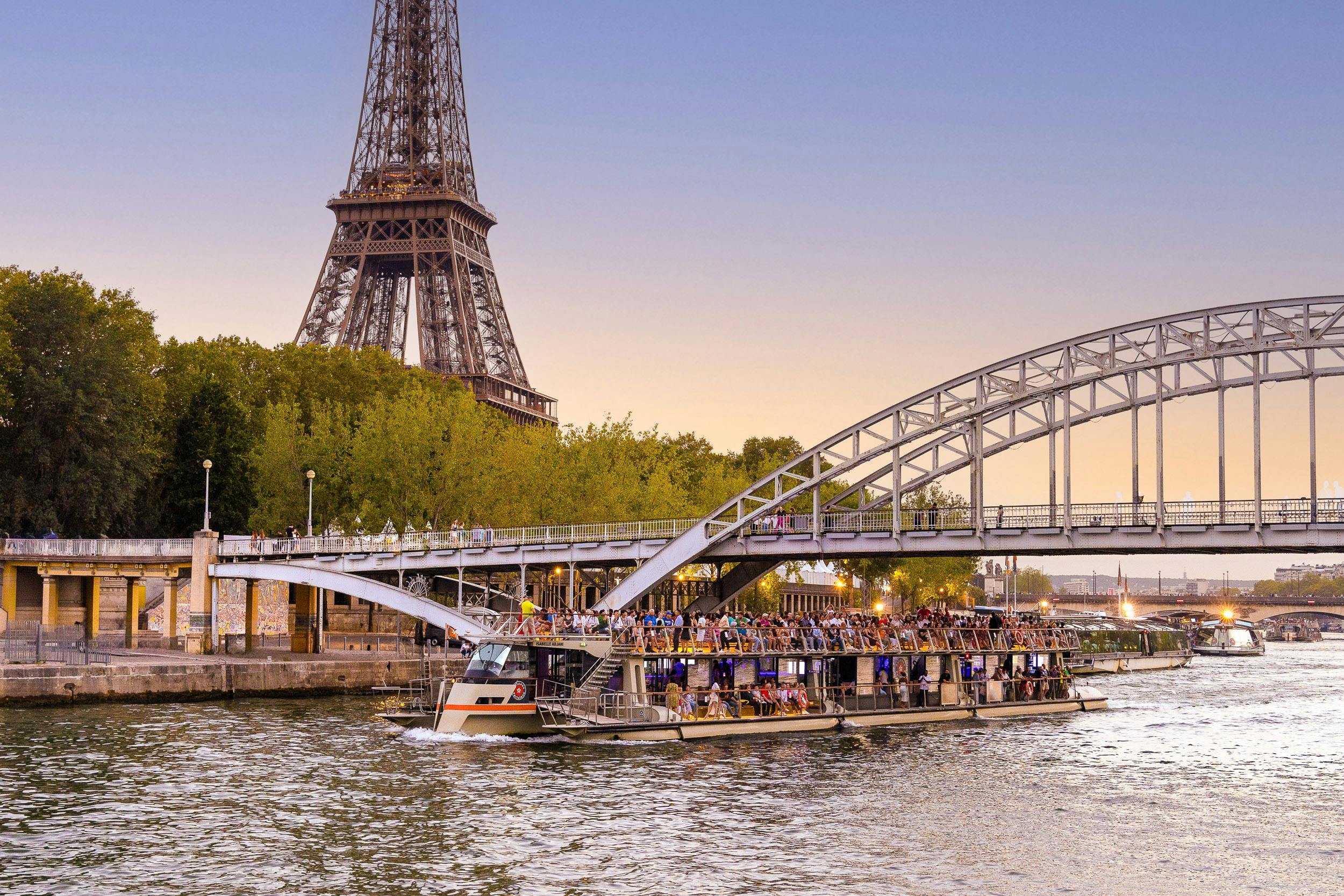
Two main operators: Bateaux Parisiens and Bateaux-Mouches, both running from €17 for a 1-hour cruise. Both have 4.3-4.4 star ratings from thousands of reviews. The cruise passes Notre-Dame (currently being rebuilt after the 2019 fire - the exterior scaffolding is visible but the island setting is still beautiful), the Louvre, Musée d'Orsay, Pont Alexandre III, and the Eiffel Tower. Evening cruises (departing 8pm-9pm) offer the best light and the Eiffel Tower sparkle effect. The practical reason to do this on day one: it gives you a full geographic orientation of the city in 60 minutes and tells you which areas you want to explore on foot.
Sainte-Chapelle and Conciergerie
The combined ticket is €26.45 and covers both sites on the Ile de la Cite. Sainte-Chapelle is one of the most extraordinary Gothic interiors in Europe: 15 stained glass windows, each 15 metres tall, covering 1,113 individual biblical scenes. Built in 1248 to house Christ's crown of thorns. On a sunny morning, the upper chapel looks like standing inside a jewel box. Most visitors to Paris skip it in favor of the Louvre and the Eiffel Tower. That's a mistake. The Conciergerie next door was Marie Antoinette's prison before her execution in 1793 - the cells are still there. Budget 2-2.5 hours for both.
- Palais Royal Gardens: Free. The arcaded gardens behind the Louvre have excellent restaurants (expensive) and the best people-watching in central Paris. Go for the architecture, not the shopping.
- Montmartre and Sacre-Coeur: Free to visit the basilica. The hilltop neighborhood has the best views over central Paris. Go before 10am - the tourist art market on Place du Tertre becomes unbearable after that.
- Centre Pompidou: €15 entry, free for EU residents under 26. Europe's largest modern art museum. The exterior escalators with city views are free - ride them even if you don't go inside.
- Marais neighborhood: Free to walk. The medieval streets between the Pompidou and Place des Vosges are the best free afternoon in Paris. Best falafel in the city on Rue des Rosiers - €6-€8 and worth the queue.
- Versailles Palace: From €12 for the gardens only, €21 for palace and gardens. Book the 9am opening slot online - the Hall of Mirrors is empty for the first 30 minutes and packed for the rest of the day.
Beyond Paris: The Best Day Trips and Regional Destinations in France
France beyond Paris is where most travelers find the experiences they talk about for years afterward. Three destinations worth planning around:
Mont-Saint-Michel: The medieval abbey on a tidal island in Normandy is one of the most photographed spots in France. Abbey entry is €16. The island is free to walk around. The tides are genuinely dramatic - at high tide the causeway floods and the abbey appears to float. Take the TGV from Paris Montparnasse to Rennes (1h30m, €35-€60) then a bus connection (1h, €15 return). Allow a full day.
Loire Valley Chateaux: Chambord (€31) and Chenonceaux (€15) are the two that consistently rank highest in visitor satisfaction. Chambord is the largest - 440 rooms, a double-helix staircase attributed to Leonardo da Vinci, and grounds the size of Paris within its walls. Chenonceaux spans the Cher River on arches, built by and for women: each of its major architects and owners was female. Rent a bike between chateaux - the Loire Valley has 900 km of dedicated cycling paths.
Provence and the South: Avignon (the Palais des Papes, €15 entry), Les Baux-de-Provence (€14), and the lavender fields of the Luberon (free, in bloom late June to mid-July) are all within 2-3 hours of Marseille by train. TGV from Paris to Marseille takes 3h15m and costs €30-€90 depending on booking lead time.
Where to Stay in Paris: Best Neighborhoods by Budget
Paris is divided into 20 arrondissements. The arrondissement number tells you roughly how central and expensive you are - 1st through 6th are the most expensive and most central, 11th through 20th offer more space and lower prices with easy metro access.
- Le Marais (3rd and 4th): Best for first-timers who want walkable access to the Louvre, Notre-Dame, and the best food streets. Boutique hotels from €120/night, budget options from €60/night in smaller guesthouses.
- Saint-Germain-des-Pres (6th): The Paris of novels and films. Expensive (mid-range from €130/night) but genuinely atmospheric. Best cafes in the city are here - Cafe de Flore, Les Deux Magots. Worth it for one or two nights.
- Bastille and Oberkampf (11th): Best value for central Paris. Mid-range hotels from €80/night. 15-20 minute metro ride to major sights. The best neighborhood restaurant-to-price ratio in the city.
- Montmartre (18th): Affordable (budget from €50/night, mid-range from €85/night) but hilly and a 20-25 minute metro ride from central sights. Best views, most atmospheric evenings.
- Opera and Grands Boulevards (9th): Good transport connections to everything. Mid-range hotels from €75/night. Less charming than Marais but practical for a busy itinerary.
Book 6-8 weeks ahead for spring and September. Paris hotel prices spike significantly in May (trade show season at Le Bourget and Cannes Film Festival effects spill into Paris) - if your dates overlap with major events, book even earlier.
How Much Does France Cost? A Real Daily Budget Breakdown
| Category | Budget Traveler | Mid-Range | Luxury |
|---|---|---|---|
| Accommodation | €30-€60/night | €90-€160/night | €200-€600/night |
| Food | €20-€35/day | €45-€75/day | €100-€250/day |
| Transport | €5-€10/day | €10-€20/day | €25-€60/day |
| Activities | €15-€35/day | €45-€80/day | €90-€200/day |
| Daily Total | ~€70-€140 | ~€190-€335 | ~€415-€1,110+ |
Budget travelers who use hostels, eat a croissant and coffee at a counter (€2.50-€4 rather than €7-€10 sitting down), take advantage of museum free days, and focus on free Paris experiences (Marais walks, Tuileries Garden, Canal Saint-Martin) can manage on €80-€110/day including one paid attraction. The formule midi (set lunch menu) at non-tourist bistros runs €13-€18 for two or three courses - the best quality-to-price ratio in French dining.
Practical Tips Before You Visit France
EU citizens enter visa-free. UK passport holders enter without a visa for stays under 90 days in any 180-day period. Most other nationalities enter visa-free for 90 days - the Schengen area rules apply. Currency is Euro. Language: French is appreciated even in minimal form - 'bonjour' and 'merci' before switching to English is not a cliché, it genuinely changes how interactions go. Paris residents speak more English than the reputation suggests, but making the effort is noticed.
Pickpocketing is the main safety concern, primarily on the metro (Line 1 and RER B from CDG are the most reported) and around major tourist sites. The Eiffel Tower area and Sacre-Coeur steps have the highest density of distraction-based theft - multiple people approaching you at once is always a setup. Keep documents in a money belt or inside zip pocket. Tipping is not mandatory in France - service is included in the bill by law. Leaving small change or rounding up is appreciated but €1-€2 is sufficient.
My Honest Take on France
France has more genuinely excellent things to see, eat, and do than most travelers can fit into a single trip - which is both the appeal and the problem. The mistake most first-timers make is trying to cover Paris plus two or three regions in a week. Pick Paris plus one day trip. See it properly. The Musée d'Orsay alone deserves three hours - most people give it ninety minutes on the way to the Eiffel Tower. The Marais deserves an afternoon of just walking - most people walk through it between two attractions. The formule lunch in a neighborhood bistro deserves a full hour - most people eat a €14 crepe standing up near the Louvre.
France rewards slowness. The travelers who get the most from it are the ones who pick fewer things and do them properly. Start by browsing current tickets and prices for France top attractions - Sainte-Chapelle, Musée d'Orsay, Arc de Triomphe, Seine cruise, Versailles, Mont-Saint-Michel. Book the ones that match your itinerary at least 2-3 weeks ahead. The difference between a good Paris trip and a great one is almost entirely pre-planning.


