
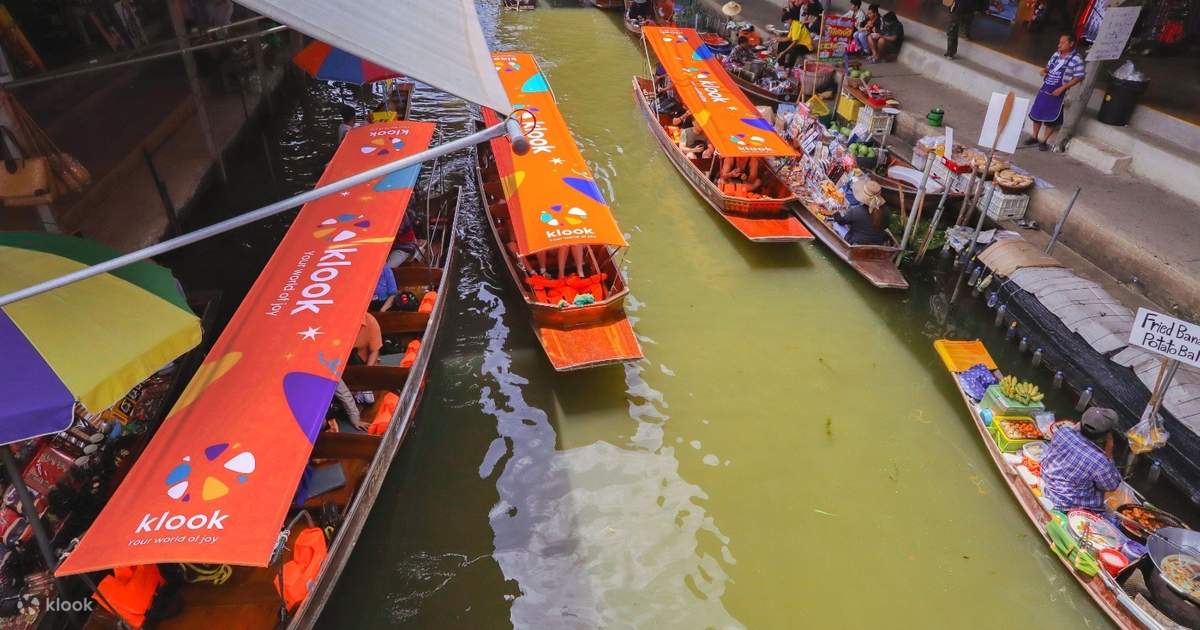
Damnoen Saduak Floating Market: Thailand's Most Famous Canal Market
The Damnoen Saduak Floating Market is perhaps the most recognized symbol of traditional Thai commerce, known worldwide for images of wooden boats laden with colorful fruits, vegetables, and cooked food paddled along narrow canals by vendors in straw hats. Located in Ratchaburi Province about 100 kilometers southwest of Bangkok, it was originally established in the late 19th century to serve the farming communities along the canal network. The market has evolved significantly over the decades, but it remains an active and genuinely functioning market, even as it has also become one of Thailand's most visited tourist attractions.
The market operates daily from around 6:00 AM to noon, with the peak activity concentrated between 7:00 and 10:00 AM. Visiting in the early morning on a tour that departs Bangkok at 6:00 AM or earlier ensures you see the market at its most active before the tourist crowds reach their midday peak. Book the Damnoen Saduak Floating Market tour on Klook which handles the early morning transportation and often includes other nearby attractions like the Rose Garden or the Maeklong Railway Market for a full-day excursion.
History of the Canal Markets
Thailand's canal markets have their roots in the country's agricultural economy and the extensive network of waterways that once served as the primary transportation system across the central plains. Before roads were built, canals connected farms, villages, and towns throughout the region. Farmers brought their produce to market by boat, and vendors paddled between communities selling goods from their boats. This system was once common across Bangkok and the surrounding provinces, with dozens of such markets operating throughout the region.
As roads replaced canals as the primary transportation network through the 20th century, most of these waterway markets disappeared. Damnoen Saduak survived partly due to its remoteness, which delayed road development, and partly because it found a new economic model as a tourist attraction once the traditional market base began to decline. The market was given a boost in 1971 when it was promoted to foreign visitors, and it has since become one of the most photographed places in Thailand.
What You Will See at the Market
The market spreads across several interconnected canals, the main one being Khlong Damnoen Saduak. The most visually striking area is the Ton Khem section, which has the highest concentration of boat vendors and is the location used in most photographs of the market. Here you will see vendors in traditional straw hats steering wooden boats loaded with tropical fruits, freshly made pad thai, grilled corn, tom yum soup, and desserts like sticky rice in banana leaves. The colors of the piled fruit and the organized chaos of boats crossing the narrow canal make for extraordinary photographs.
The canal banks are lined with souvenir shops, restaurants, and vendor stalls selling clothing, crafts, and snacks. This area can feel quite commercial and many items are priced at tourist rates. The more authentic market experience is on the water itself, either by renting a small boat to navigate the canals or watching the boat vendors from the canal-side walkways. Bargaining is expected for most souvenir purchases but food items typically have fixed prices.
| Area | Character | Best For |
|---|---|---|
| Ton Khem Canal | Most photogenic, busy boat vendors | Photography, buying fresh fruit |
| Khlong Damnoen Saduak | Main canal, wider, more commercial | General browsing, boat rides |
| Ban Khun Phitak | Less touristy section | More authentic atmosphere |
| Canal Bank Market | Permanent stalls, souvenirs, food stalls | Shopping and eating |
Boat Rides and How to Navigate
One of the most enjoyable ways to experience the market is by renting a small rowboat paddled by a local guide through the side canals away from the main tourist area. These rides give access to quieter sections where vendor boats still operate in a more traditional manner. The boat rides typically last 30 to 60 minutes and cost around 100 to 150 THB per person with a guide. Bargaining for boat rides is common but be clear about the route and duration before departing.
Motor boats are also available for hire and give a faster circuit of the main canal areas. These are louder and generate exhaust but are faster and can cover more of the market in less time. If arriving independently rather than on a tour, hiring a boat guide is the best way to see the most interesting sections. The Bangkok evening food tour by tuk-tuk later in the day offers a very different angle on Thai food culture, this time in an urban street food context that complements the morning market experience.
- Arrive before 8:00 AM to see peak activity before crowds build
- Book a guided tour from Bangkok to handle early morning logistics
- Rent a canal rowboat for the most authentic experience
- Bring small denomination Thai baht for boats and snacks
- Be ready to bargain for souvenirs but not for food
- Wear light clothing and bring a hat for sun protection on the water
- Combine with Maeklong Railway Market for a full-day trip
| Info | Details |
|---|---|
| Opening Hours | 6:00 AM - 12:00 PM (peak 7-10 AM) |
| Location | Damnoen Saduak district, Ratchaburi Province |
| Distance from Bangkok | ~100 km, about 1.5-2 hours by road |
| Entry Fee | Free (boat rides and activities cost extra) |
| Best Day to Visit | Weekdays for fewer tourists |
| Getting There | Organized tour is easiest; AC bus from Bangkok Southern Terminal also available |
Maeklong Railway Market Combination
Many tours from Bangkok combine the Damnoen Saduak Floating Market with a visit to the Maeklong Railway Market, which is located about 25 kilometers away in Samut Songkhram Province. The Maeklong market is famous for the way vendor stalls are set up directly on the active railway tracks, with awnings and displays that retract just minutes before the train passes through. The train operates several times daily and the spectacle of the market reorganizing itself around the train and then immediately reopening is genuinely impressive.
Adding the Maeklong Railway Market to your morning makes for a full and varied day of traditional Thai market culture. Both markets together give an insight into how Thai trading communities adapted their commercial activities to their physical environment, whether that environment was a canal network or a railway line. For more Bangkok-area day trips, the Ayutthaya temples tour heads north to the ancient capital and offers a completely different historical experience.
Best Time to Visit and What to Buy
The floating market is open daily but is at its most active and photogenic from Tuesday to Sunday. Mondays can be slower with fewer boat vendors. The optimal visiting window is from opening time at 6:00 AM through to about 9:30 AM, after which the largest tourist groups arrive on later departing Bangkok tours. If you are particularly interested in photography, arriving at or just after 6:00 AM when the light is soft and vendors are actively setting up provides the most atmospheric conditions.
For purchasing food at the market, grilled corn, fresh coconut, tropical fruit platters assembled in front of you, and freshly made pad thai cooked in a wok on a boat are all worth trying. Souvenirs tend to be generic, but handmade items like woven baskets, cotton clothing, and local herbal products are more interesting options. For a more comprehensive introduction to Bangkok-area food culture, the Bangkok evening food tour visits the city's most interesting street food neighborhoods by tuk-tuk.
Planning Your Bangkok Day Trip Itinerary
The Damnoen Saduak Floating Market works well as a morning activity that ends by noon, leaving your afternoon free for other Bangkok activities. If your tour returns you to Bangkok by 1:00 PM, you have time to visit the Grand Palace and Emerald Buddha in the afternoon. Many visitors find that pairing an early morning market experience with an afternoon palace and temple visit gives a well-balanced day covering both the commercial and ceremonial sides of Thai culture.
For a multi-day Bangkok itinerary, consider spending three days in the city before heading north to Chiang Mai for the Elephant Jungle Sanctuary or south to Phuket for island adventures. Bangkok offers essentially unlimited things to see and do, but the Grand Palace, the floating market, an evening food tour, and a day trip to Ayutthaya make for an excellent four-day introduction to the city and its surroundings. The Muay Thai boxing match in Bangkok is another evening option that adds excitement and local culture to your Bangkok nights.
Getting a Thailand Visa and Entry Requirements
Most visitors to Thailand can obtain a visa on arrival or qualify for a visa exemption depending on their passport. Citizens of over 60 countries including the United States, United Kingdom, Australia, most EU nations, and many Asian countries can enter Thailand without a visa for stays of up to 30 days (with some countries receiving 60 days). The visa exemption policy has been expanded and extended multiple times in recent years and Thailand actively encourages tourism. Always verify the current requirements with the Royal Thai Embassy in your country before traveling, as policies can change.
For stays longer than the visa exemption period, a tourist visa (TR) can be applied for at a Thai embassy or consulate in your home country before departure. The tourist visa allows a 60-day stay with a possible 30-day extension at a Thai immigration office. Thailand has land borders with Myanmar, Laos, Cambodia, and Malaysia, and many long-term visitors use border crossing runs to renew their visa exemption status, though immigration policy on this practice has tightened. Once in Thailand, the Grand Palace and cultural sites in Bangkok make excellent first stops before heading to beach destinations or the north.
Transportation Within Thailand
Thailand has an extensive domestic transportation network that makes it easy to travel between regions. Bangkok's international Suvarnabhumi Airport (BKK) and the older Don Mueang Airport (DMK) both handle international and domestic flights. Thai Airways, Bangkok Airways, Air Asia, Nok Air, and Lion Air operate frequent domestic routes connecting Bangkok to Chiang Mai, Phuket, Krabi, Ko Samui, and other major destinations. Domestic flights are affordable and the journey from Bangkok to Chiang Mai takes approximately one hour versus 10-12 hours by train or bus.
The overnight sleeper train from Bangkok to Chiang Mai is a classic Thailand experience, departing Hua Lamphong station in the evening and arriving the next morning. The train is comfortable with private sleeper berths available and the views of the central plains and northern hills are excellent. For shorter distances, Thailand's extensive bus network connects cities and towns throughout the country at low cost. Tuk-tuks and songthaews (shared pickup trucks) provide local transportation within cities and towns. In Bangkok, the BTS Skytrain and MRT metro systems are efficient for navigating the city. The Bangkok food tour by tuk-tuk gives you a genuine tuk-tuk experience while exploring the city's best food neighborhoods.
Budget Planning for Thailand
Thailand offers excellent value across all budget levels. Budget travelers can live comfortably on USD 30-50 per day covering guesthouses, street food, local transportation, and attraction entry fees. Mid-range travelers spending USD 80-150 per day can stay in comfortable hotels, eat at sit-down restaurants, and book organized tours. Luxury travel is also available at internationally competitive prices with world-class resorts available throughout the country.
The biggest expense categories for most visitors are accommodation, day trips, and alcohol. Street food meals typically cost 50-150 THB (USD 1.50-4.50), while restaurants serving international food charge 300-600 THB (USD 9-18) per person. Organized day tours like the Ayutthaya temples tour or the Phi Phi Islands day trip typically cost USD 25-70 per person. Temple entry fees are generally 50-200 THB while major attractions like the Grand Palace cost 500 THB. Budget carefully for southern Thailand islands where boat tours and accommodation are significantly more expensive than the mainland.
| Expense Category | Budget (THB/day) | Mid-Range | Luxury |
|---|---|---|---|
| Accommodation | 300-600 THB | 1,200-3,000 THB | 5,000+ THB |
| Food | 200-400 THB | 600-1,500 THB | 2,000+ THB |
| Local Transport | 100-200 THB | 300-600 THB | 800+ THB |
| Activities/Tours | 500-1,000 THB | 1,500-4,000 THB | 4,000+ THB |
| Total Daily Estimate | ~1,100-2,200 THB | ~3,600-9,100 THB | ~11,800+ THB |
Thailand Itinerary Ideas
A classic one-week Thailand itinerary covers Bangkok for three days, then flies to Phuket or Krabi for four days of beaches and islands. In Bangkok, the Grand Palace half-day tour on day one, the Damnoen Saduak Floating Market on day two morning, and the Ayutthaya day trip on day three gives an excellent cultural foundation. In the south, the Phi Phi Islands day tour and the James Bond Island Phang Nga Bay tour cover the two best day trips from Phuket.
A two-week itinerary can add Chiang Mai in the north for three to four days, with the Elephant Jungle Sanctuary and the Chiang Mai hill tribes trekking tour as the main activities. An evening Muay Thai boxing match in Bangkok and the Bangkok evening street food tour complete the Bangkok nights experience. For those with three weeks, adding the Krabi area for Krabi 4 Islands snorkeling and time on Koh Samui or Koh Phangan gives a comprehensive Thailand experience covering culture, nature, wildlife, and beach life.
Health and Safety in Thailand
Thailand is generally a safe destination for international visitors. The main health considerations are sun protection, hydration in the tropical heat, and food safety. Drink bottled or filtered water rather than tap water throughout the country. Street food from busy stalls with high turnover is generally safe and far fresher than food that has been sitting. Hepatitis A, typhoid, and routine vaccinations are recommended for visits to Thailand. Dengue fever is present throughout the country so using insect repellent, particularly at dawn and dusk in outdoor areas, is advisable.
Travel insurance with medical coverage and evacuation coverage is strongly recommended for Thailand. The country has excellent hospitals in Bangkok, Chiang Mai, and Phuket with internationally trained doctors, but medical care can be expensive. Thailand's political history has seen periods of instability and occasional coups, but the country has remained stable for visitors in recent years and tourism infrastructure continues to develop. The Thailand Tourism Authority (TAT) operates assistance centers in major tourist areas and at airports.
Photography Tips for Damnoen Saduak Floating Market
Photographing Damnoen Saduak Floating Market well requires understanding the best light conditions and camera positions. The golden hour immediately after sunrise and in the hour before sunset produces the warmest and most flattering light for both architectural and landscape photography. At many popular Thailand sites, arriving for sunrise is worthwhile not only for the light but also because you will have the site largely to yourself before the tour buses arrive. At outdoor sites with reflective water surfaces, calm mornings produce the best reflections and mirror-like conditions that disappear once wind picks up.
The best market photography captures movement - the paddling motion of vendors, the exchange of goods between boats, and the stacking of colorful produce. Standard photography guidelines apply throughout: shoot in RAW format if your camera supports it for maximum post-processing flexibility, bring extra batteries as cold temperatures drain batteries faster, protect your equipment from rain and dust with appropriate cases, and use a polarizing filter for shots of water and sky which dramatically reduces glare and deepens colors. A travel tripod is worth carrying for interior low-light shots at temples and museums where flash is typically not permitted.
Early morning backlit shots through the mist that often sits over the canals in the first hour after opening create atmospheric and distinctive market photographs. Photographing people at markets, temples, and cultural sites in Thailand should always involve seeking permission, particularly for close portrait shots. Most people are happy to be photographed when asked respectfully, and the gesture of asking rather than photographing without awareness is both ethical and often results in better photographs as subjects are more relaxed and engaged. At busy tourist sites, patience pays off: waiting for a clear moment when other tourists are not in the frame often means waiting only a few minutes at less popular viewpoints, while major landmarks may require either very early arrival or longer waits for clear compositions.
Where to Stay in Bangkok
Bangkok has accommodation options across a wide range of price points and styles. Budget travelers will find guesthouses and hostels in the Banglamphu near Khao San Road area of the city or town from approximately USD 12-20 per night, often with breakfast included and common areas that make meeting other travelers easy. These budget options are clean and functional if not luxurious, and their central locations offset the lack of amenities. For those who prefer more comfort, USD 50-100 range hotels offer private rooms with air conditioning, en-suite bathrooms, reliable WiFi, and often swimming pools.
Luxury travelers will find internationally branded hotels as well as boutique hotels in heritage buildings that combine high standards of service with locally distinctive character. Thailand has invested substantially in tourism infrastructure and the quality of accommodation at all price levels has improved significantly over the past decade. Booking in advance is strongly recommended for visits during peak season when the best-value properties fill up weeks or months ahead. Staying in the most central area of Bangkok generally adds convenience and reduces transportation costs, though properties slightly outside the tourist center often offer better value and a more local atmosphere.
Disclosure: This article contains affiliate links. If you book through our Klook links, we may earn a small commission at no extra cost to you. This helps us keep producing free travel guides for readers like you. We only recommend experiences we genuinely believe are worth your time and money.


