
Hagia Sophia has been a Byzantine cathedral, an Ottoman mosque, a secular museum, and since 2020, a working mosque again — each phase leaving visible layers, from Christian mosaics partially uncovered near the entrance to Islamic calligraphy roundels the size of small buildings hanging from the dome. Few structures anywhere let you read a thousand years of religious history in a single glance upward.
Entry is now free as a functioning mosque, though non-Muslim visitors use a separate entrance and upper gallery, and modest dress is required regardless of faith. Prayer times close the main floor to sightseeing five times daily — checking the schedule before visiting saves a wasted trip to the door. It sits directly across the plaza from the Blue Mosque, and most visitors see both in the same outing.

The Blue Mosque takes its name from the more than 20,000 handmade İznik tiles lining the interior, an effect that shifts colour with the light through 200 windows across the dome. It sits directly across the plaza from Hagia Sophia — the two buildings were deliberately built to face and answer each other, Ottoman sultan responding to Byzantine emperor centuries apart.
As an active mosque, it closes to visitors during the five daily prayers, and modest dress (covered shoulders and legs, headscarves provided for women) is enforced at the door. A guided visit pairing both buildings back to back is the standard and honestly the correct way to see either — the architectural conversation between them is most of the point.

Topkapi Palace was the administrative heart of the Ottoman Empire for roughly four centuries, and the complex is large enough — four courtyards, plus the Harem as a separate paid ticket — that most visitors underestimate how long a proper visit takes. The treasury holds the Topkapi Dagger and an 86-carat diamond among other imperial relics; the Harem section requires its own entry fee and is easy to miss if not planned for.
A guided tour is worth it specifically for the Harem's maze-like private quarters, where context matters more than almost anywhere else in the palace. Views over the Bosphorus from the fourth courtyard are free and among the best in the old city, worth the walk even for anyone skipping the paid sections.

Built in the 6th century to supply water to the Byzantine Great Palace, the Basilica Cistern holds 336 marble columns rising from shallow water in near-total darkness, lit now by coloured spotlights that turn the whole space genuinely atmospheric rather than merely functional. Two columns rest on giant Medusa head carvings, reused from an earlier Roman structure — nobody is entirely certain why they were placed sideways and upside down.
The cistern sits a short walk from both Hagia Sophia and the Blue Mosque, making it an easy add-on rather than its own trip. It's cool year-round given its underground position, a genuine relief during Istanbul's hot summer months, and a guided visit adds the Byzantine engineering context a self-guided walk through the columns tends to miss.

One of the oldest and largest covered markets on Earth, the Grand Bazaar holds around 4,000 shops across 61 covered streets — genuinely easy to get lost in without a guide, and structured enough that different sections specialise in carpets, gold, ceramics or leather rather than everything mixed together.
Bargaining is expected here, not optional; a guided tour is worth it mainly for knowing realistic starting prices before the negotiation begins, which first-time visitors otherwise have no benchmark for. Morning visits, before tour groups arrive in volume, make the actual shopping experience considerably calmer.

Smaller and more purely food-focused than the Grand Bazaar, the Spice Bazaar has traded saffron, Turkish delight and dried fruit since the 1660s, and the sensory version of Istanbul — colour, scent, the calls of vendors — concentrates here more than almost anywhere else in the old city.
Guided food tours through the bazaar typically include tastings unavailable to walk-in shoppers and steer toward stalls selling genuine Turkish delight rather than the imported, lower-quality versions that have become common near the entrances. The surrounding streets, less touristed than the bazaar itself, are worth extending a visit into for anyone with an extra half hour.

Istanbul is the only city in the world spanning two continents, and a Bosphorus cruise is the most direct way to feel that — Europe on one shore, Asia on the other, waterfront palaces and fortresses from both empires visible in the same hour-long stretch of water.
Sunset cruises are the most-booked slot for good reason, catching the strait's bridges and mosque silhouettes lit against the sky. Dinner cruises add a full evening with entertainment; a shorter daytime sightseeing cruise covers the same landmarks for a fraction of the price and time commitment, worth it for anyone tight on schedule.

Dolmabahce Palace replaced Topkapi as the imperial residence in the 19th century, and the shift in style is the whole point of visiting — European Baroque and Rococo influences, a four-and-a-half-tonne crystal chandelier gifted by Queen Victoria, and a scale of Western-facing opulence that Topkapi's older Ottoman rooms never attempted.
Mustafa Kemal Atatürk, the founder of modern Turkey, died in this palace in 1938; all its clocks are still set to the time of his death, 9:05, as a tribute. Entry is by guided group tour only — walking through unaccompanied isn't an option — which makes booking ahead more important here than at most Istanbul sites.

Built by the Genoese in the 14th century as part of their fortified trading colony, Galata Tower now offers one of the few panoramic views over both the old city's minaret skyline and the Bosphorus in a single frame — arguably a better overall photo than the Bosphorus cruise itself, just from a fixed point rather than moving water.
Sunset tickets sell out first and cost the same as any other slot. The surrounding Galata and Karaköy neighbourhoods, dense with cafés and independent shops, reward lingering after the tower visit rather than treating it as a quick photo stop and moving on.
Istanbul's major sights cluster densely around Sultanahmet — Hagia Sophia, the Blue Mosque and Topkapi Palace are all within a short walk of each other — while the Bosphorus waterfront and the Asian side sit further out, which is where hop-on hop-off buses and ferries earn their cost.
Guided sightseeing tours add the layered Byzantine-then-Ottoman history a self-guided walk skips entirely, since so much of what's visible today sits directly on top of earlier structures. First-timers with one day do best combining Sultanahmet's walkable core with a single Bosphorus cruise rather than trying to also reach the Asian side in the same visit.

Istanbul's deeper cultural tours tend to move past Sultanahmet into neighbourhoods like Balat and Fener, where Ottoman-era wooden houses in faded pastel colours and historic Greek and Jewish quarters tell a more layered version of the city's religious and cultural mixing than the main tourist sites alone.
A Bosphorus-village tour reaching Ortaköy and its waterfront mosque, or a food-and-culture combination through the Asian side's Kadıköy market district, are both worth the extra distance for a second or third day. These run at a slower, more conversational pace than the big Sultanahmet tours.

A private Istanbul tour pays off fastest around the Sultanahmet cluster, where a private guide can sequence Hagia Sophia, the Blue Mosque and Topkapi Palace around each other's prayer-time closures and crowd patterns in a way a fixed-group schedule often can't.
Families and travellers uneasy navigating a genuinely unfamiliar transit system get the clearest value from a private driver-guide covering both the European and Asian sides in one day. Worth booking specifically for a custom day combining the Grand Bazaar with a private Bosphorus boat charter — a pairing no set-menu group tour package typically offers.

The Istanbul Museum Pass covers Topkapi Palace, the Basilica Cistern and several other paid sites over five consecutive days, and pays for itself once you're visiting three or more — fewer than that, standalone tickets usually cost less overall.
Hagia Sophia and the Blue Mosque are both free as active mosques, so the pass mainly matters for the paid museums and palaces rather than the city's two most iconic buildings. Dolmabahce Palace's guided-tour-only entry still requires its own advance booking regardless of pass status.

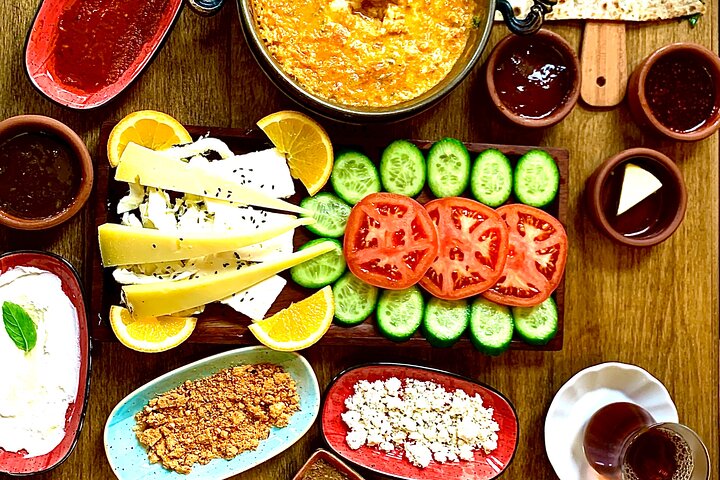
An Istanbul food tour typically moves through the Spice Bazaar's stalls, a working simit (sesame bread ring) vendor, and a proper kebab or meze meal, covering more genuine local eating in one outing than a week of hotel breakfasts. Kadıköy on the Asian side has become the food-tour destination of choice among residents themselves, less touristed than Sultanahmet's restaurant strip.
Turkish tea and coffee culture — thick, unfiltered coffee served with a glass of water, endless refills of black tea from a çay bahçesi garden — gets its own dedicated stop on most well-run tours. Evening food tours pair naturally with a Bosphorus-view dinner afterward.

Istanbul's multi-day packages are unusually dominated by one destination: Cappadocia, roughly an hour's flight away, famous for sunrise hot air balloon flights over its cave-dwelling fairy-chimney rock formations. A typical itinerary spends two or three days in Istanbul covering Sultanahmet and the Bosphorus, then flies to Cappadocia for a night or two built around the balloon flight.
These packages solve the flight booking and hotel-transfer logistics between two very different parts of Turkey, which is the main value over planning each leg separately. Worth it specifically for the Cappadocia balloon flight, weather-dependent and best arranged well ahead rather than on arrival.

The Princes' Islands, a ferry ride from the city centre, ban private cars entirely — the main transport is horse-drawn carriage or bicycle, which makes for a genuinely different pace than anywhere else near Istanbul. Büyükada, the largest island, is the standard day-trip destination, with 19th-century wooden mansions and pine forests replacing the city's density almost entirely.
For travellers with a longer stretch of time, Gallipoli's WWI battlefields and Troy's ancient ruins are both feasible as long single days from Istanbul, though each deserves a dedicated trip rather than combining both. Closer options exist for anyone with only half a day free — even a short Bosphorus ferry to the Asian side counts as a change of pace without leaving the city.
