
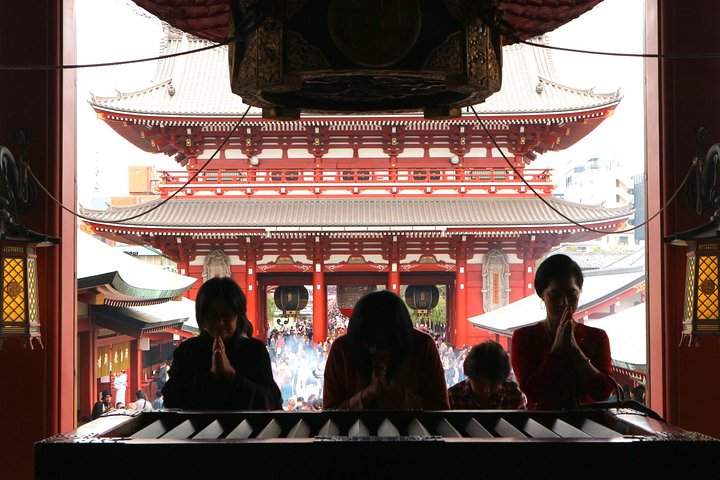
Senso-ji is Tokyo's oldest temple, founded in the year 645, and the Nakamise shopping street leading up to its thunder gate has been selling souvenirs and snacks to pilgrims for roughly four centuries — which makes the tourist-trap feel of the approach, oddly, historically accurate rather than a modern invention.
The temple itself is free and never closes, though the crowds thin out dramatically before 8am and after the tour buses leave in late afternoon. A guided Asakusa tour usually extends past the temple into the surrounding old-Tokyo streets — rickshaw rides, traditional craft shops — that a temple-only visit skips entirely.

Meiji Shrine sits inside a forest of 100,000 trees planted specifically for it a century ago, and the walk in from the main gate is long enough that the traffic noise of surrounding Tokyo genuinely disappears before the shrine buildings come into view. Weekend mornings sometimes catch a traditional Shinto wedding procession crossing the main courtyard.
Takeshita Street in neighbouring Harajuku is the deliberate contrast — a narrow, crowded lane of crepe stands, cosplay boutiques and teenage fashion louder than almost anywhere else in the city. Tours pairing both in one morning cover the widest possible range of Tokyo's personality in the shortest walk.

Up to 3,000 people cross Shibuya Crossing at once when all directions release simultaneously, and the best view of the scale of it is free — the Starbucks on the second floor of the Tsutaya building, or the Shibuya Sky observation deck if the queue is worth it that day.
Guided Shibuya tours typically extend into Shibuya Sky's rooftop deck, Center Gai's arcade-and-shopping backstreets, and often a stop at the Hachiko statue, the loyal dog memorial that's become the city's default meeting point. Night visits catch the crossing at its most photographed, with every screen and neon sign in the district lit at once.

Tokyo Tower, red-and-white and modelled loosely on the Eiffel Tower, is the older and more nostalgic of the city's two towers, its observation deck lower but its retro presence arguably more photogenic against the skyline. Tokyo Skytree, at 634 metres, is taller than almost anything else in the world and delivers a correspondingly bigger view, weather permitting — Mount Fuji is visible from the top deck on clear winter days.
Skytree's higher tier costs more and involves a second elevator change; the lower deck alone satisfies most visitors. Sunset tickets for either tower sell out first and cost the same as any other slot — book that specific window if the transition from daylight to lit skyline matters to you.

The Imperial Palace is still the working residence of Japan's Emperor, which means the inner grounds stay closed to the public most of the year — what visitors actually see is the East Garden, free to enter, and the palace's outer stone walls and moat from Kokyo Gaien plaza.
Twice a year, on the Emperor's birthday and January 2nd, the inner grounds open for public greetings, drawing crowds well beyond a typical tour day. Outside those dates, a guided walk through the East Garden and surrounding plaza covers the site properly in under two hours, usually paired with nearby Tokyo Station's restored red-brick façade.

Akihabara built its identity on post-war electronics shops and has since layered anime, manga and gaming culture on top — multi-storey stores selling everything from vintage arcade cabinets to collectible figures, alongside maid cafés that have become a tourist draw in their own right regardless of interest in the broader otaku culture.
Guided Akihabara tours help mainly with context: which stores are genuine specialist retailers versus tourist-priced novelty shops, and which retro arcades still run original hardware rather than reproductions. Evening visits catch the neon signage at its most overwhelming, which is very much the point of visiting after dark.

The wholesale tuna auctions moved to Toyosu in 2018, but Tsukiji's outer market stayed put and remains the better food-tour destination for visitors — dense with sushi counters, knife shops and street-food stalls that never depended on the auction floor to begin with.
A guided food tour here means someone who already knows which stall's tamagoyaki is worth the queue and which sushi counter seats walk-ins without a reservation. Morning visits, before 10am, get first pick of the freshest stock; by early afternoon many of the best stalls have already sold out their daily supply.

Mount Fuji is visible from Tokyo on clear winter mornings, but seeing it properly means the Fuji Five Lakes region, about two hours out, where Lake Kawaguchiko's shoreline gives the classic mountain-reflected-in-water photo without an actual summit climb — the climbing season itself only runs July to early September.
Most day trips combine a lake-area visit with a stop at Oshino Hakkai's spring-fed ponds or a ride on the Mount Fuji Panoramic Ropeway for an elevated view. Cloud cover is the real variable here — Fuji hides behind haze more mornings than it doesn't, and no tour operator can guarantee visibility, only the best statistical odds by season.

Tokyo's neighbourhoods each have such a distinct character — Asakusa's old-Tokyo streets, Shinjuku's neon density, Ginza's luxury retail — that a guided sightseeing tour earns its cost mainly through sequencing, moving between contrasts efficiently on a rail network that's fast but not always intuitive for first-time visitors.
Day bus passes work well for a self-guided approach across the same ground. First-timers with limited time do best pairing one guided half-day covering two or three neighbourhoods with a single major ticketed sight — Tokyo Skytree or the Imperial Palace — rather than trying to self-navigate everything.

Tokyo's cultural tours tend to work best when they pick a specific tradition rather than trying to summarise the whole city — a tea ceremony experience, a sumo stable morning practice visit, or a walk through Shinjuku Golden Gai's tiny post-war bars, each seating six people at most.
Shinjuku Gyoen's formal gardens offer the quieter counterpoint to the district's neon core, worth a guided stop for anyone who wants traditional Japanese landscaping without leaving central Tokyo. These tours run smaller and slower than the big sightseeing loops, and reward reading reviews for the specific guide rather than the theme alone.
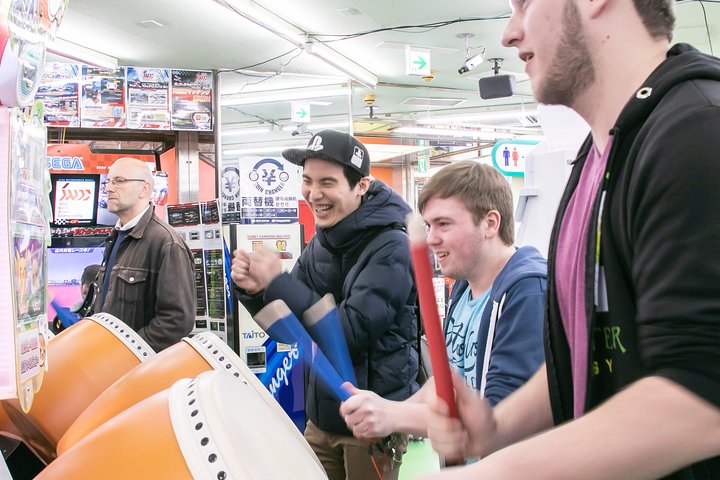
A private Tokyo tour solves the language and navigation gap more directly than in most cities — a private guide handles rail transfers, restaurant ordering in areas with limited English, and the etiquette details (shrine visit customs, tipping norms that don't exist here) that trip up first-time visitors.
Families and travellers with specific interests get the clearest value: a custom day mixing a sumo morning-practice visit with an Akihabara afternoon, or a private guide who can adjust on the fly if a shrine visit runs long. Worth booking specifically for any day requiring real logistics — a Mount Fuji day trip with flexible timing, for instance, rather than a fixed-departure bus schedule.

Tokyo doesn't have the queue culture of European capitals — most temples and shrines are free and rarely crowded enough to need a skip-the-line ticket — but the major paid observation decks and teamLab-style digital art museums are the exception, both known to sell out entirely on weekends.
City passes bundling transit and a few attractions make sense mainly for visitors doing heavy rail travel across multiple days; for sightseeing alone, standalone tickets to Tokyo Skytree or a specific museum usually cost less than a bundled pass. Book anything digital-art or observation-deck related as soon as dates are fixed.
A Tokyo food tour usually means an izakaya crawl through Shinjuku's Omoide Yokocho alleyways — grilled skewers and beer in stalls barely wider than the counter itself — or a more structured route through Tsukiji's outer market stalls during the day.
Ramen-focused tours are their own genre entirely, moving between three or four shops specialising in different broth styles rather than one restaurant meal. Evening food tours pair naturally with a Shibuya or Shinjuku night walk afterward, since most wrap up early enough to leave the rest of the night free.

Tokyo is flatter and more orderly for cycling than its density suggests, with dedicated riverside paths along the Sumida River connecting old Asakusa to the modern Odaiba waterfront in a route a walking tour simply can't match for ground covered.
Early morning departures beat both the traffic and the pedestrian crowds that build through the day in central districts. Night bike tours through Shibuya and Shinjuku's lit streets are the increasingly popular alternative — a different way to see neon density that a bus window doesn't quite deliver.

A multi-day Tokyo tour typically front-loads Asakusa and the Imperial Palace on day one, adds Shibuya and Harajuku on day two, and leaves a day for a Mount Fuji excursion or a deeper neighbourhood dive into Shinjuku or Akihabara.
These suit first-time visitors with four or more days more than a quick weekend — the value is in someone else having solved the rail-transfer logistics between neighbourhoods, which is the single biggest source of wasted time in a self-planned Tokyo itinerary.

Hakone, about 90 minutes by train, is the classic Tokyo day trip — hot spring baths, a pirate-ship cruise across Lake Ashi, and on clear days a Mount Fuji view from the lake's ropeway that rivals the Fuji Five Lakes region itself. Nikko, roughly two hours north, trades hot springs for elaborately carved Shinto and Buddhist shrines set into forested mountains, quieter than most Tokyo day trips despite the scenery.
Kamakura, closer and coastal, rounds out the options for a shorter half-day trip built around its Great Buddha statue and beach town atmosphere. Each of these works as a standalone day; combining more than one in a single trip usually means less time at each than the destination deserves.


